
Why the Model Is Quietly Breaking
For decades, outbound calling has been the backbone of collections strategy in credit unions. When a loan becomes delinquent, the response is straightforward: Pull a list. Start dialing. It feels proactive. Responsible. Member-focused. And in a relationship-driven institution, picking up the phone has long signaled care.
But across the country, something subtle is happening inside collections departments. Teams are working harder than ever. Staffing remains tight. Call volumes remain high. Yet payment resolution timelines aren’t improving at the same rate.
The issue isn’t effort. It’s a model design.
The Operational Reality: Dialing Is Expensive, Even When It “Works”
Let’s examine a typical outbound attempt.
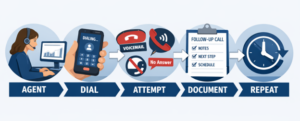
An agent:
- Reviews account notes
- Dials
- Waits for the ring cycle
- Leaves voicemail (if unanswered)
- Documents attempt
- Schedules follow-up
Even conservatively, that’s 4–6 minutes per attempt.
Now multiply that across:
- 1,000 delinquent accounts
- 2–4 attempts per account
- A blended hourly wage and benefits
It becomes clear quickly: outbound dialing is not a minor line item. It’s structural labor. And that’s assuming the call is answered. Industry-wide contact rates for outbound collections calls frequently sit well below 50%. In many institutions, they are far lower. Which means more than half of the effort is spent on:
- Ring cycles
- Voicemails
- Follow-up tasks
- Administrative documentation
In other words, the cost structure assumes human initiation at scale. That’s workable when labor is abundant, and expectations are stable. Neither condition is true today.
The Member Behavior Gap
The larger shift is behavioral. Members have quietly changed how they prefer to transact. They:
- Pay bills digitally
- Respond to texts faster than emails
- Avoid unknown phone numbers
- Expect asynchronous resolution
Meanwhile, the collections operations are often designed around synchronous conversation. The friction isn’t visible at first. But it shows up in metrics:
- Increased dial attempts per successful contact
- Longer resolution cycles
- Higher average handle time
- More agent burnout
It’s not that members don’t want to resolve their balances; it’s that the communication channel doesn’t match how they live. When a member answers and says, “Can you just send me the link?” that moment reveals something important:
The phone call wasn’t the payment mechanism. It was simply a trigger. If the trigger is expensive, the system is expensive.
The Hidden Financial Model: A Rough Illustration
Let’s simplify the math and assume:
- 1,200 delinquent accounts
- 3 dial attempts per account
- 5 minutes per attempt
- $28/hour fully loaded cost
That’s:
- 1,200 x 3 x 5 minutes = 18,000 minutes
- 18,000 minutes ÷ 60 = 300 labor hours
- 300 hours x $28 = $8,400
And that’s for one cycle. Now consider repeat cycles, partial payments, or recurring delinquencies. Outbound dialing scales linearly with volume. There’s no leverage. Every additional account requires additional minutes. Digital engagement does not scale the same way.
Compliance, Risk, and Emotional Cost
Outbound collections calls also carry operational complexity:
- Call recording and storage compliance
- Script adherence monitoring
- Dispute management
- Escalation handling
- Fair lending considerations
Every live conversation introduces variability. And variability increases management oversight burden. But there’s another cost, one rarely quantified. Agent fatigue.
Dialing into voicemail loops all day is not energizing work. High-repetition outbound tasks drive turnover, and turnover increases training costs and quality inconsistency. It’s not just inefficient. It’s unsustainable.
From Human-Initiated to Member-Initiated Engagement
There is a structural shift underway. The shift is from human-initiated to member-initiated engagement. The institutions seeing measurable change are not removing people from collections. They are changing the initiation model.
Instead of:
They begin with:
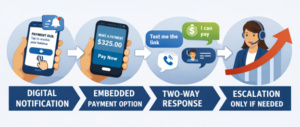
The difference is foundational. When members receive: “Your payment is due. Tap here to resolve.” A significant percentage complete the transaction without conversation.
For those who reply:
- “Text me the link.”
- “Can I pay on Friday?”
- “I have a question.”
The interaction becomes contextual rather than cold. The agent enters mid-stream, not at the beginning. That is operational leverage.
What Changes When the Model Changes
Institutions that shift toward digital-first, two-way engagement often report:
- Reduced outbound dial volume
- Shorter average handle times
- Higher self-service completion rates
- Faster cure rates
- Improved staff morale
Not because collections got softer. Because friction was removed from the system. The phone becomes a precision instrument, not a blunt one. Human conversation becomes high-value rather than high-volume.
The Strategic Implication for Leadership
This is not simply a technology conversation. It is a cost-structure conversation. Outbound dialing is a labor-dependent model in a labor-constrained environment. Digital-first engagement is a leverage-dependent model in a margin-sensitive environment.
As lending margins tighten and operational budgets face pressure, leadership teams are beginning to ask:
- Are we staffing around friction?
- Or designing friction out of the system?
That question reframes the discussion entirely.
A Practical Leadership Audit
If you want clarity, review:
- Dial attempts per successful payment
- Percentage of payments completed without live conversation
- Average handle time for payment-related calls
- Cost per cured delinquent account
- Agent turnover rate within collections
If the majority of time is spent attempting contact rather than resolving accounts, the model deserves examination. Not because it’s wrong. Because member behavior has evolved.
Where This Is Going
Outbound calls will not disappear. There will always be moments that require human nuance. But they should be reserved for:
- Complex hardship conversations
- Disputes
- High-balance exposure
- Sensitive escalations
Not routine payment reminders.
The institutions that modernize this layer are not abandoning relationships. They are protecting them by making resolution easier, faster, and less intrusive. And in doing so, they reduce cost while improving experience. That’s not a technology upgrade; it’s a structural one.
FAQ
Q: Why are outbound collections calls becoming less effective?
Outbound calls are labor-intensive, often go unanswered, and are misaligned with modern member communication preferences. Digital-first engagement reduces friction and scales more efficiently.
Q: What is the alternative to outbound dialing in credit unions?
A digital-first, two-way engagement model that allows members to self-serve payments and initiate human assistance only when needed.

